LC Num 21
First I didn’t understand the problem I think. In the sense that I accepted the inputs as two lists and returned a list - Python list. Then I read it and realized they want the operation in Linked lists.
i took some time to recall how to move along a list and finally figured it out.
The other thing that gave me a minor ankle break was when the test case was two empty lists.
Handled that as well eventually.
Here’s the cumulative code -
 1class Solution:
 2    def mergeTwoLists(self, list1: Optional[ListNode], list2: Optional[ListNode]) -> Optional[ListNode]:
 3        c = []
 4        a =[]
 5        b=[]
 6
 7        i = list1
 8        j = list2
 9        while i:
10            a.append(i.val)
11            i = i.next
12        while j:
13            b.append(j.val)
14            j = j.next
15        i, j = 0 , 0
16        while i < len(a) and j < len(b):
17            if a[i] < b[j]:
18                c.append(a[i])
19                i = i + 1
20            else:
21                c.append(b[j])
22                j = j+1
23        if j < len(b):
24            c.extend(b[j:])
25        elif i < len(a):
26            c.extend(a[i:])
27        if len(c) > 0:
28            listNode3 = ListNode(c[0],None)
29            head = listNode3
30            for i in c[1:]:
31                temp_node = ListNode(i,None)
32                listNode3.next = temp_node
33                listNode3 = listNode3.next
34        else:
35            head = None
36
37        return head
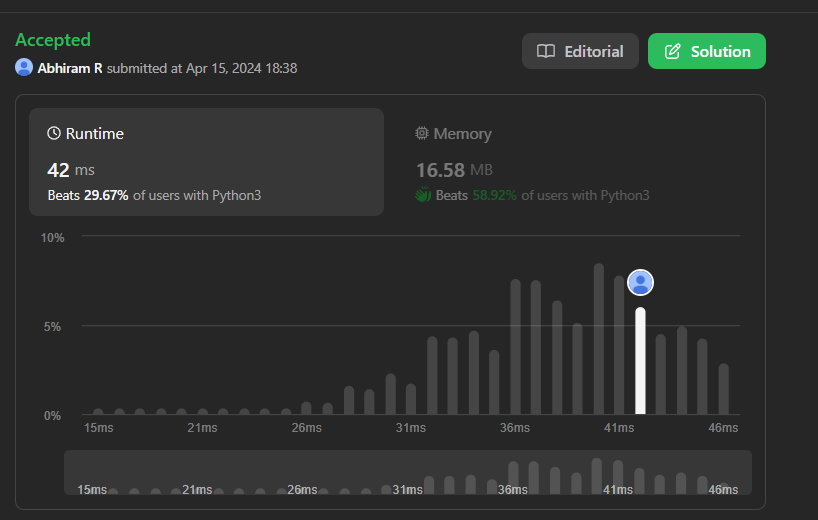
And boom!

By minorly changing the above code to not create lists out of ListNodes initially, a speedup of 2 seconds can be achieved -
 1class Solution:
 2    def mergeTwoLists(self, list1: Optional[ListNode], list2: Optional[ListNode]) -> Optional[ListNode]:
 3        c = []
 4        a =[]
 5        b=[]
 6
 7        i = list1
 8        j = list2
 9        while i and j:
10            if i.val < j.val:
11                c.append(i.val)
12                i = i.next
13            else:
14                c.append(j.val)
15                j = j.next
16        if j:
17            while j:
18                c.append(j.val)
19                j = j.next
20
21        elif i:
22            while i :
23                c.append(i.val)
24                i = i.next
25        if len(c) > 0:
26            listNode3 = ListNode(c[0],None)
27            head = listNode3
28            for i in c[1:]:
29                temp_node = ListNode(i,None)
30                listNode3.next = temp_node
31                listNode3 = listNode3.next
32        else:
33            head = None
34
35        return head